

A founder’s perspective from Dan Swithinbank, Founder of FYER.
Charities and smaller organisations are often working with limited time and resources. When information is spread across emails, documents, project sites and different systems, finding what you need and keeping everything up to date can become a job in itself.
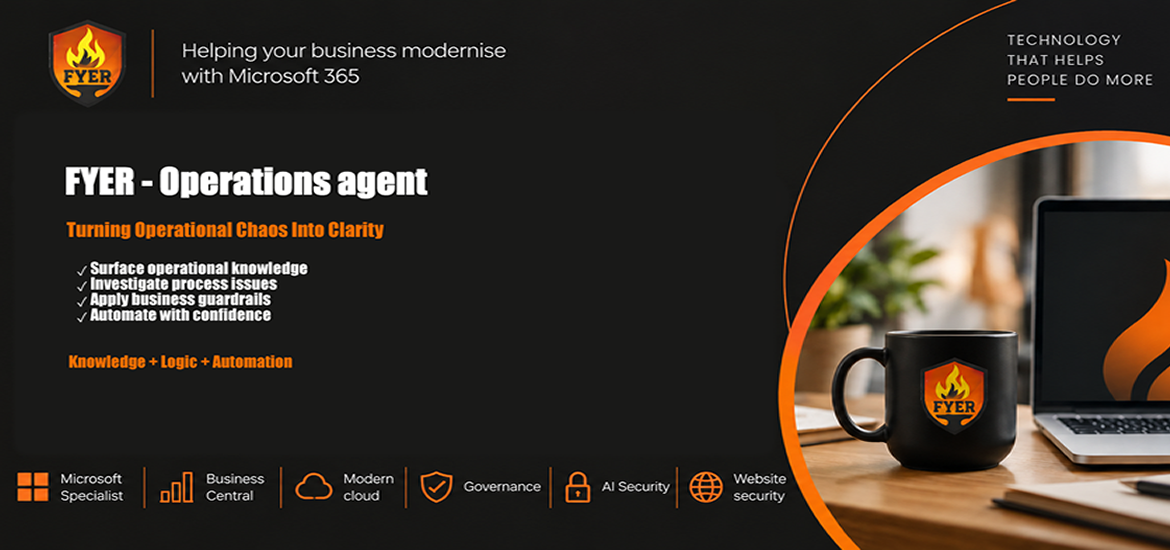
Dan Swithinbank, Founder of FYER, has developed the FYER Operations Agent, an AI-powered solution that connects Microsoft 365 with business systems and structured workflows. The aim is to help organisations do more than simply ask a chatbot questions. It’s about using automation to connect information, support everyday processes and reduce repetitive administration.
We spoke to Dan about why he started the project, how it works and what it could mean for charities and smaller organisations.
The problem: information is everywhere, but not always easy to find
In many organisations, useful information is held across a variety of places. Teams may use Microsoft Teams for conversations, SharePoint for documents and other systems to manage customers, projects and business information.
Although each tool has a purpose, moving between them can create extra work. Staff might need to search for details, check previous conversations, create records manually or update information in more than one place, creating data sprawl.
For charities, where teams are often balancing operational responsibilities with delivering services and supporting their communities, that time matters.
Dan’s project is designed to help bring information together and make it easier to act on it, using tools and processes that organisations may already have in place.
Why build an AI-powered operations tool?
The FYER Operations Agent grew from the opportunity to make everyday business operations easier to manage.
By connecting Microsoft Copilot with systems such as Business Central, SharePoint and Teams, the solution is being developed to help users access relevant information and carry out tasks through more structured processes.
Rather than treating AI as a standalone question-and-answer tool, the idea is to make it part of how work gets done: helping people find information, organise it and move processes forward.
As Dan explains:
“I bring the systems together so they talk to each other in a way that makes them useful.”
The focus is on making the technology work together in a way that supports the organisation’s day-to-day operations.

Automation beyond a chatbot: Creating workspaces with purpose, governance and security
A chatbot can be useful for answering questions, but Dan’s approach goes further by exploring how an AI-connected workflow can initiate actions.
The FYER Operations Agent is designed to be used through Teams or Copilot, allowing staff to interact with the system while working in familiar environments.
“You can actually get to the operations agent, and just use it in Teams.”
One example involves creating a customer record. A workflow will check Business Central for an existing record, helping to identify potential duplicates before moving forward. It can then support the creation process and connect relevant project information and documents.
Dan demonstrated how the process can ask for confirmation before creating a record. Further approval steps, such as requiring a CEO’s approval, can also be incorporated into workflows where appropriate.
He describes this as “human in the loop” keeping a person involved at the relevant point in the process.
The task flows are working, and the FYER Operations Agent will continue to develop as FYER builds on its capabilities and explores new ways to help organisations work smarter.
The wider principle is that AI can be connected to defined processes, allowing organisations to automate appropriate steps rather than relying on staff to complete every action manually.
Connecting customer records, projects and documents
Keeping information connected is an important part of the FYER Operations Agent.
When customer details, project information and documents are held in different places, staff can spend time trying to establish which information belongs together and whether it is up to date.
The solution explores ways to connect these elements, using structured records and identifiers to help organise information. Dan explained that the Business Central customer ID can act as an anchor, with projects linked through their own IDs.
Information added to a project file can also be tagged with its project ID, helping users find relevant documents they have permission to access.
Project views can provide a snapshot of work, including status and ownership, making it easier for teams to understand what is happening. The system can also be used to query project and customer information.
Dan describes the intended benefit simply:
“It just keeps a finger on the pulse, right? That’s the point of it.”
This can support a clearer view of work across a team, as well as helping individuals keep track of their own responsibilities.
Governance and human oversight matter
Automation needs to operate within appropriate boundaries, particularly when it involves organisational information.
Dan has developed governance instructions and a SharePoint structure to help define what the system can access and how it should behave. The agent is intended to be grounded in organisational data only,rather than allowing the agent to search the wider internet.
As he puts it:
“I don’t want any internet access. It has to be grounded in organisational data only.”
The intention is to keep the agent working with the organisation’s own information and established controls. Governance structures can also help shape how information is accessed and how workflows operate.
Approval steps can be configured where a process requires human oversight. This means organisations can determine which actions are suitable for automation and where a person should review or confirm what happens next.
The appropriate controls will depend on the organisation, its systems and the workflows being implemented. As with any developing AI solution, organisations should consider access permissions, governance and oversight as part of implementation.
Can automation help when something goes wrong?
The project has also explored how automation might help with certain recovery tasks.
One demonstration involved functionality designed to rebuild particular Teams sites if they are deleted. Dan described how he had tested the process:
“I wanted it to self-heal and create all the team sites and it did it, all of it, all in one go and just put it all back together and rebuilt it.”
This illustrates how workflows could potentially support recovery from some operational problems, rather than only handling routine administration.
The FYER Operations Agent is designed to rebuild Teams sites and project information using organisational metadata. Human and agent interactions are logged in a separate list, allowing changes to be tracked by the agent. This means that even the project list can be recovered or rebuilt, helping maintain continuity when information or structures need to be restored.
Keeping AI automation practical and affordable
Cost is an important consideration for smaller organisations exploring AI.
Dan explained that keeping AI usage and costs manageable involves more than simply creating workflows. Providing context through multiple workflows, using agents to orchestrate tasks and giving the system well-structured prompt instructions can help make the approach more cost-effective.
“If you create multiple workflows for context, use agents for orchestration and have well-structured prompt instructions, it makes it a lot cheaper.”
This approach can help manage AI usage, including token consumption. Dan has also explored non-AI alternatives using Power Apps, recognising that some tasks may be better handled through conventional automation.
The project has explored a project-based commercial model. Costs will depend on factors such as the tools and licences involved, usage, complexity and the workflows required. There is no single fixed running cost that applies to every organisation, and licensing requirements should be considered alongside any implementation or support costs.
Who is it designed for?
Dan’s focus is on charities, start-ups and smaller independent organisations that want to make better use of technology without approaching the problem as a large corporate transformation programme.
As he explained:
“I want to support charities and NFPs achieve their social mission, I have a drive to enable and help this sector.”
He went on to describe the kinds of organisations he feels the approach could suit:
“Charities, startups, you know, small independents.”
The intention is to look at the practical tasks that take up staff time and consider where connecting systems or automating defined steps could make a difference.
The right starting point will vary by organisation. A useful first step is to identify a repetitive process, understand where its information currently lives and decide which parts could be supported by automation while retaining appropriate human oversight.
A practical starting point for smarter working
AI and Microsoft 365 automation are not simply about introducing another tool. They offer an opportunity to reconsider how information is organised and how everyday work moves between systems, improving business operations.
The FYER Operations Agent explores how Copilot, Business Central, SharePoint and Teams can work together through structured workflows, from finding and connecting information to supporting actions and selected recovery tasks.
For charities and smaller organisations, the value lies in identifying processes where this approach could reduce repetitive administration and make information easier to manage, while keeping governance and people at the centre.
Automation beyond a chatbot is about making technology work in the background, connecting systems, supporting processes and helping people spend less time managing information and more time doing the work that matters.
About Fyer
Modern cloud consultancy built for real-world budgets.
Founded by Dan who is passionate about aligning technology with governance, mentoring, fostering innovation, protecting organisational IP and creating resilient IT ecosystems that enable sustainable growth and value delivery.
Contact Dan today for a no-obligation chat or to find out more.

